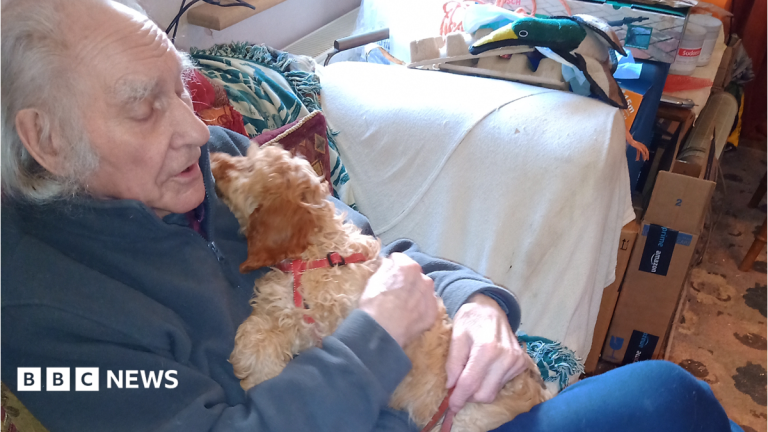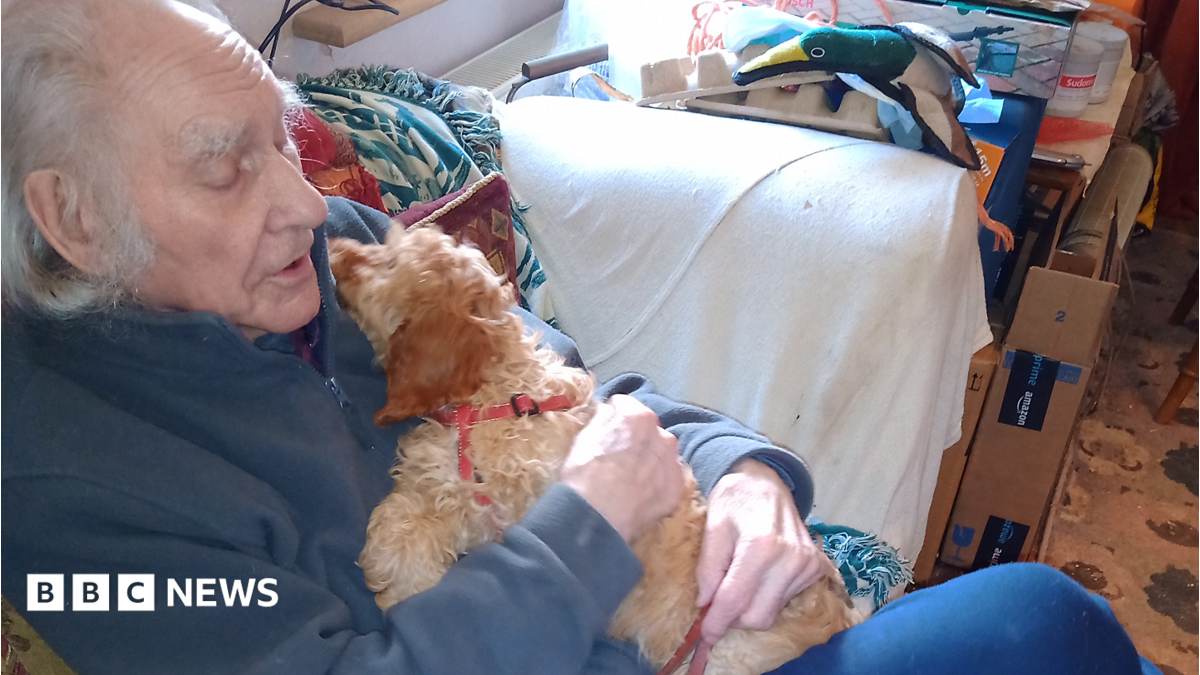
As her husband of more than 40 years lay dying in a hospital bed, Kate Baxter was not even allowed to hold his hand without wearing protective gloves.
Paul suffered a stroke in December 2025 and, four months before he died in June aged 90, caught scabies in hospital.
In his final days, Kate could only touch him while wearing the rubber gloves after he contracted the highly contagious skin infestation, external at Glangwili Hospital, Carmarthen.
Hywel Dda health board said it was taking extra measures to control the spread of scabies and was focused on keeping hospitals and healthcare settings as clean as possible.
"He was suffering. He said to me, 'my back itches' and when I rubbed his back, his skin was coming off like sand," she said.
"To have him die like that wasn't good."
Scabies is caused by microscopic mites burrowing under the skin and it spreads through close skin contact.
Kate, from Cwrt Newydd in Ceredigion, said Paul also had pneumonia, but the crusted scabies meant his immune system "had weakened".
Paul died on 8 June – scabies is noted as a secondary cause of death on his death certificate.
Kate said the undertaker told her Paul had a tag on him saying "environmental hazard" while his body was in the morgue.
"It means the scabies were still active on him," she added.
"You don't expect your husband to go into hospital with one thing and then come out via the morgue as a health hazard."
Kate said, before he was admitted to hospital, Paul was "very bright" and "funny".
"He had an inquiring mind, even at that age. He was great to be around, he enjoyed life," she said.
By February, he told his wife he was feeling itchy but Kate said doctors thought it might be an allergic reaction to medication.
She said it was 12 weeks and six days before he was diagnosed in May, by which point it had developed to the more severe crusted scabies.
People with this type of scabies can have up to two million mites and eggs on them.
Kate also contracted scabies from Paul and described it as "dreadful".
She added: "You've got an itch, like something you'd have in the middle of the back, and you just simply cannot get rid of it and your skin is constantly in pain.
"They're worse at night because that's when they're most active and you'd get this suddenly sharp stabbing pain in your leg or your back, and then it's sort of multiplied out. It's distressing."
Kate feels the infection cast "a shadow" over her husband's final weeks and days and took away "the quality of time together".
She said, if her husband had not caught scabies, then "possibly his immune system wouldn't have been compromised and he possibly would be able to fight off the pneumonia that he caught In the end".
Kate was given personal protective equipment – similar to that used by medical professionals during Covid – to wear while visiting him in hospital.
"Holding somebody's hand with gloves is not good," she said.
After Paul's death, Kate wrote to the health board to complain about how long it took to diagnose him with scabies.
Chief executive Phil Kloer replied saying they had not identified any evidence that concerns regarding the rash were ignored or "that there was a failure to seek appropriate medical review".
He added the health board were "unable to determine with certainty whether the rash could have been prevented".
Kate said she was unhappy with the response and felt the health board "skated over" the issues, adding that doctors should have "realised sooner that it wasn't just a skin condition".
In July, Glangwili Hospital's Steffan ward was closed to treat a scabies outbreak, followed by the Cadog ward in September – both have since reopened.
The Teifi ward has been closed since 21 September.
This week Hywel Dda health board also closed two wards at Prince Philip Hospital in Llanelli because of scabies.
The latest published data in Wales shows there were more than 27,000 reported consultations in the Common Ailments Service, external for the condition last year, compared to 4,810 two years earlier.
Hywel Dda confirmed some treatments had been cancelled due to the ward closures and said any people affected would be "contacted proactively as soon as we know that we may need to change their scheduled appointment".
Director of public health Ardiana Gjini said: "We are working in partnership with our other partner agencies, Public Health Wales, our local authority colleagues, so that we ensure that that potential transmission that happens through the community is reduced and is controlled.
"Infection prevention is much broader and much higher than just what patients might see as clean or not clean.
"However, we are very focused in maintaining our hospitals and our healthcare settings as clean as possible, and we ask everyone to help with that."
Gjini added that the infection did put "additional burden on our staff and on our services, but also crucially on our patients, carers, and the whole community".
Prof Tess McPherson of the British Association of Dermatology said she had noticed a rise in the infection, but said it was "impossible to avoid" and had been "unnecessarily stigmatised".
She added: "It's not to do with being dirty, it's not to do with poor hygiene. We're seeing it in all age groups – particularly young people, children and babies.
"I've certainly seen lots of people that may not even want to tell their sexual partners or people they're living with they've got scabies, which clearly is going to lead to ongoing issues with people having scabies, transmitting scabies and not accessing the right treatments."
About the Author