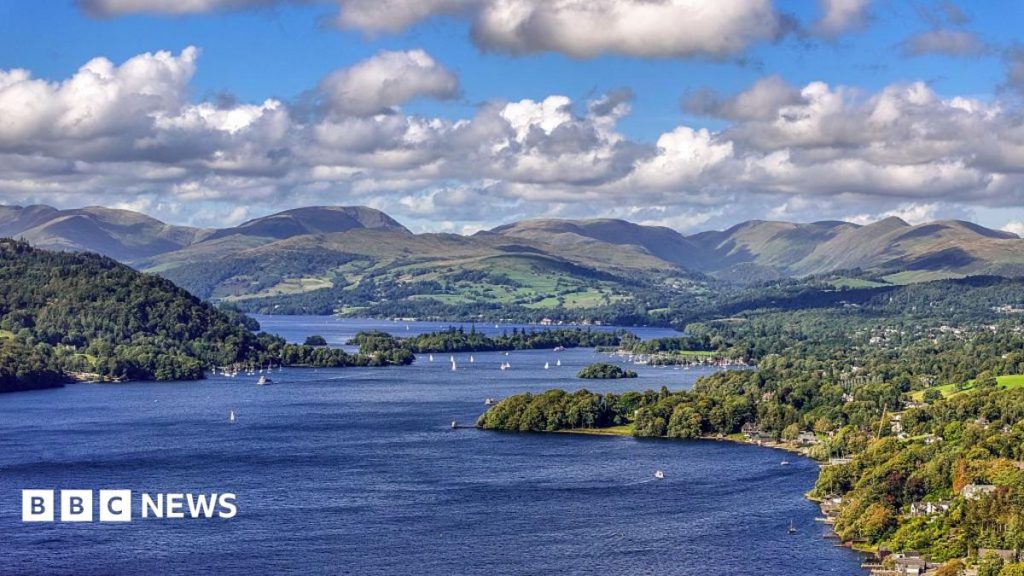
A £3.6bn proposal to stop sewage being discharged into Windermere, England's largest lake, has been unveiled.
The plans, which are backed by the local water company United Utilities and clean water campaigners, would see a tunnel up to 12 miles (19km) long built to transport sewage away from the lake.
At the moment both raw sewage and treated effluent are discharged into Windermere and campaigners say that is why parts of the lake have been turning green each summer, so-called algal blooming.
It is now up to the government to decide if the plan can be further developed, and if the £3.6bn price-tag is acceptable.
The Lake District is a Unesco World Heritage site and attracts close to 18m visitors each year.
Windermere is at its heart, with the lake holding around 300bn litres of water. That is so big that it can take 9 months for water entering one end to reach the other.
Louise Beardmore, chief executive of United Utilities, told the BBC the proposals were a "100 year solution for this lake".
"In the UK we invest in five year periods and so we come along all the time and we do a bit, then we go away and we come back and do a bit more. This is saying we need to do something differently," she said.
Beardmore said she was excited that a broad coalition including her company, regulators, the local authorities and environmental campaigners had come together to draft this proposal which is called "Only Rainwater into Windermere" (ORiW).
Perhaps the unlikeliest member of the group is activist Matt Staniek. He called today's proposal a "milestone".
"For me this is a plan on a piece of paper. It is not definitive action and that's what I want to see." he said. "This is the beginning, and the end of this is the moment that sewage stops entering Windermere."
It will now be up to the government to decide whether the plans are developed further, and if so how.
At present the sewage network around Windermere is fragmented, with homes served by a mix of public wastewater treatment works and privately owned treatment facilities and septic tanks.
When treatment works are overwhelmed, such as during heavy rain, they spill raw sewage. The rest of the time they emit a continuous stream of treated effluent which, while cleaner than raw sewage, can contain high nutrient levels.
On several occasions in the last five years the high nutrient levels and warm temperatures have combined to cause algal blooming turning parts of the lake a lurid green.
The ORiW proposal would see 12,800 people connected to the sewage network for the first time with up to 86 miles (138km) of new sewage infrastructure and a single wastewater treatment works built to serve them at the end of a 4m-wide sewage tunnel.
Two slightly different plans are being put forward. Both have the tunnel at their heart but one would see the treated effluent discharged into the River Leven, the other into the Irish Sea at Ulverston.
The report highlights two options for paying for the project.
One would see the cost passed on to United Utilities' customers and would -depending on the route chosen – add up to £3.17 to their monthly bills.
People like Nigel Wilkinson from Love Windermere group, which is linked to many local businesses, would like the cost to be spread nationally, increasing all bills in England by up to 35p a month.
"We believe Windermere is of such national significance and international significance that it is justifiable to treat this as a national asset and fund it accordingly," he says.
Much now depends on the government's enthusiasm for following through on promise made then Environment secretary Steve Reed in March 2025 to stop all sewage going into Windermere.
"We share the public's determination to protect this iconic lake." a Department for Environment, Food and Rural Affairs spokesperson said, stressing that further work needed to be done to test alternative options.




Discussion