Published21 October 2026, 16:06 BST
The King has described the Aberfan disaster which killed 116 children and 28 adults as the "most tragic of days imaginable" on its 60th anniversary.
Pantglas Junior School and a number of nearby houses in the village near Merthyr Tydfil, south Wales, were catastrophically engulfed in coal slurry after the colliery spoil tip collapsed on 21 October 1966.
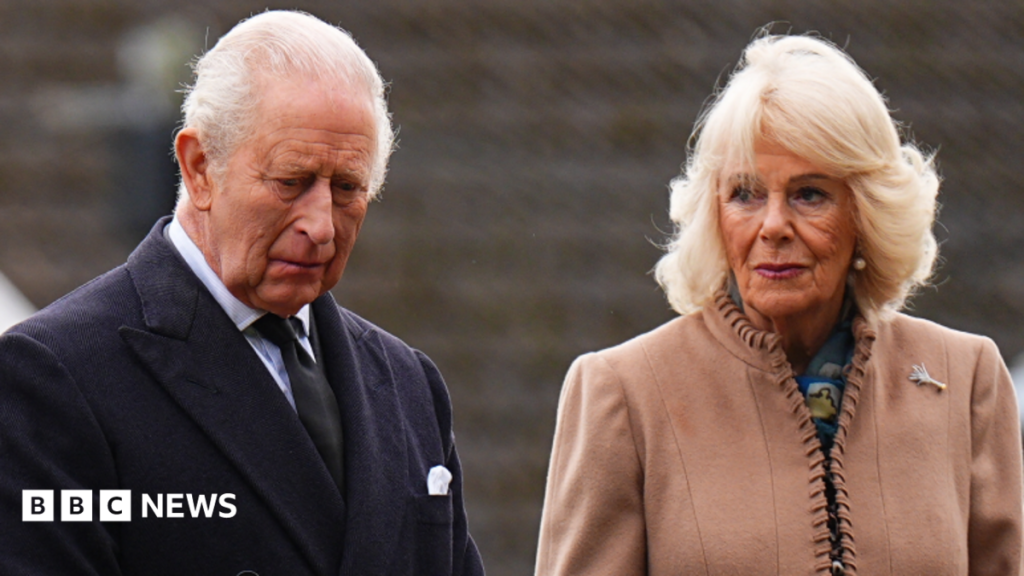
King Charles III, Queen Camilla and the Prince of Wales joined survivors and bereaved families on Wednesday and laid wreaths and a posy with the last surviving teacher in the Aberfan Memorial Garden, located on the site of the school.
The King also paid tribute to the community's strength, resilience and "unconquerable spirit".
Warning: This story contains upsetting details that some may find distressing
About half the children from the school died when excavated mining debris from the Merthyr Vale Colliery was dislodged, and 150,000 tonnes of coal waste came thundering down the hillside.
Emergency services, miners and people who rushed to the village began an around-the-clock battle to dig out those trapped by the debris.
An official inquiry found the National Coal Board was responsible for the disaster, but no-one has ever been prosecuted.
On Friday morning a minute's silence was held at 09:15 BST to mark the moment the coal spoil struck the village, and church bells rang 144 times for each child and adult who died.
Pupils at Ynysowen Community Primary School, which was built to carry on the legacy of Pantglas, also gathered to pay their respects.
The royals joined survivors, bereaved parents and members of the community in the memorial garden to pay tribute to all those who lost their lives, followed by a visit to the nearby Aberfan and Merthyr Vale Community Centre.
First Minister Rhun ap Iorwerth also greeted crowds of people in Aberfan, with flowers that Aberfan victims would have seen in their gardens chosen for the wreaths laid in the garden.
Who was responsible for the Aberfan disaster?
The coal waste had been piled high on the side of Mynydd Merthyr – above Aberfan – for years, even though there were numerous underground springs below.
An official inquiry in 1967 found the National Coal Board was responsible for the Aberfan disaster, but survivors and bereaved families have long pointed to a litany of injustices.
Money was taken from the public disaster fund to help pay for the removal of remaining coal tips above the village, while compensation payments were limited and survivors had to undergo repeated assessments.
Support to help deal with their trauma was also minimal.
Professor Iain McLean, the co-author of Aberfan – Government and Disaster, has questioned why nobody was ever prosecuted for the Aberfan disaster.
Speaking on the BBC Radio Wales Phone In on Wednesday, he said: "And so one of the other failures of the government of the day is their, to me, incomprehensible failure to sack Lord Robens and his senior directors."
Robens was the chairman of the National Coal Board at the time, and had faced numerous complaints about the dangers that loomed a quarter of a mile high above the village.
One of these included a petition from Pantglas school in 1963, three years before the disaster.
In 1997, McLean met three of the counsels who had appeared before the 1967 tribunal and asked why no legal action was taken.
"They all said 'nobody thought of it at the time'," he said.
Image source, Press Association
Image source, Getty Images
On Wednesday the royal party met retired members of the emergency services at the community centre who helped in the hours and days after the disaster.
They then spent time with survivors, bereaved parents, and siblings of those who died.
In a speech to those in the community centre, King Charles said the disaster "was and always will be, the saddest and most tragic of days imaginable".
He said: "Over the years, as once again today, it has been profoundly humbling to hear the testimonies of survivors of relatives who lost their loved ones, and of rescuers who fought so hard to save others during this appalling tragedy."
"Today in our nation and across the world, thoughts will turn to you in Aberfan, hearts far from this valley will ache with yours."
King Charles added: "Throughout all this, and through all the years, your unconquerable spirit has shone all the more brightly for the darkness which it has overcome.
"No one should ever have to bear what you, as a community, have endured, but no one could have borne it with greater strength, resilience, or hope.
"Please know how deeply we feel with your sorrow, how greatly we admire your strength, and how you will, always, be in our hearts."
Jeff Edwards, who survived the disaster as an eight-year-old pupil, said in a speech that October 21 1966 was "forever etched into our memory, a day of unimaginable tragedy and loss that changed the lives of families and the community forever".
"Yet, amidst the terrible sorrow, we were comforted by those who came to stand with us to share our grief and offer their support," he said.
"The presence of members of the royal family in those difficult years became a lasting and deeply valued part of Aberfan's history."
Prince William also visited Ynysowen Community Primary School to unveil an Aberfan Memorial Tree.
The tree was designed and created by ArtMetal, a family-run metalwork company based in Rhayader, Powys.
The concept was developed by school headteacher Simone Roden, along with Edwards who is vice chair of governors at the school.
During the early planning stages, pupils helped shape the vision of the memorial by sharing drawings and ideas.
During the visit, Prince William met pupils and heard them recite poems they had written about the disaster and read memories recorded by the children who survived.
"Well done guys," William told the pupils.
"It shows the next generation does care about them, and it matters."
Before unveiling the sculpture, he watched the pupils perform the Aberfan Song and well-known children's song Everyone Belongs.
Prince William, Prince of Wales
More coverage
Royal Family to visit Aberfan to mark 60 years since disaster
Prime minister visits Aberfan ahead of 60th anniversary of ‘horrifying tragedy’
Tributes paid to ‘bravest’ woman who died of ‘stab wounds’ after crash

Discussion