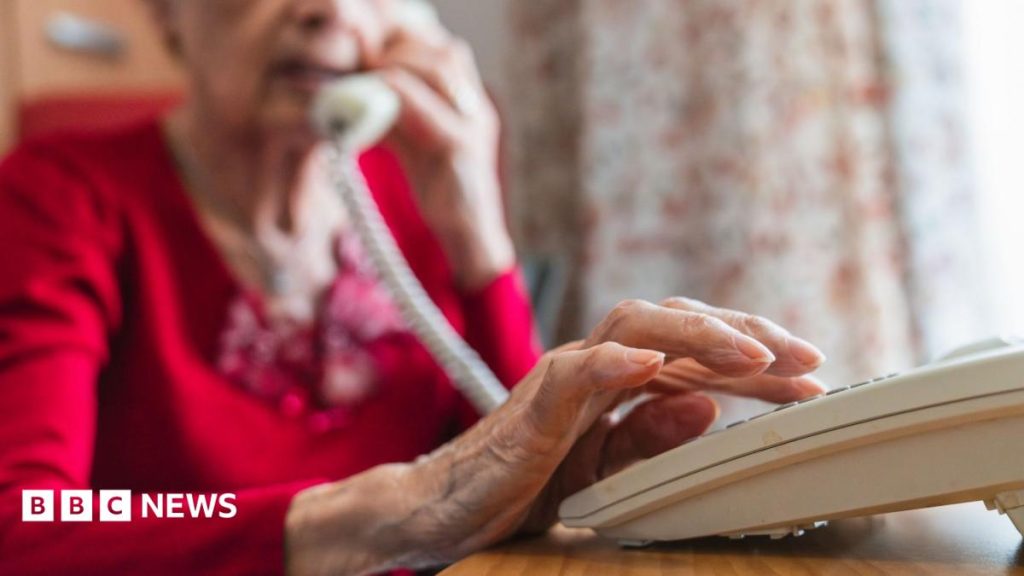
Plans to switch off the UK's traditional landline phone network could leave people in remote areas unable to contact help in an emergency, MPs have warned.
Landline operators aim to complete the switch to an internet-based network instead of copper-wire cables by the end of January next year.
The government and operators say the move to digital landlines will offer a more reliable service.
But MPs representing remote areas of the UK urged security minister Dan Jarvis to ensure that scrapping the copper-wire network did not make their communities more vulnerable in a storm or other emergency.
Unlike digital services, the traditional landline network does not rely on mains electricity and continues to work in a power cut.
Labour MP Torcuil Crichton, who represents the Western Isles constituency of Na h-Eileanan an Iar, said: "Resilience is inbuilt in the islands but we have major problems with connectivity because of this move from analogue to digital phone lines."
He said that "when the power goes out people don't have the phone, they don't have the internet and often they don't have a mobile signal either".
BT OpenReach has been giving back-up battery packs to vulnerable customers, which can keep landline phones operating for an hour or more.
But Crichton said this was "simply not adequate" and that mobile phone providers "simply don't have the means to maintain or keep their signal going during storms".
He urged the minister to get telecoms firms to "up their digital game" to protect places "on the edge where people are vulnerable, isolated from their neighbours, where the ambulance is an hour away and the storm is 70 miles an hour".
Similar concerns were raised by MPs from the West Country and the Lake District.
Markus Campbell-Savours, Labour MP for Penrith and Solway, said: "I ask the minister to imagine an elderly constituent living alone in an isolated Lake District valley where copper phone lines have been replaced by fibre.
"A storm takes out the power to their router in the night and by the time they wake, the modest battery back up has failed, as has the mobile mast, does the minister share my concerns that they would have no way to raise an alarm in an emergency and agree that we need a new technological solution to protect the elderly?"
'We won't be able to use our phones if we have a power cut'Published22 December 2025
'We won't be able to use our phones if we have a power cut'
Published22 December 2025
Switchover must protect most vulnerable – MPsPublished24 March 2025
Switchover must protect most vulnerable – MPs
Conservative MP Julian Lewis also raised concerns about the lack of a "back-up system" if digital phone services go down in the event of a cyber attack or other emergency.
He told Jarvis the copper-wire network "could have given us useful levels of resilience in an emergency".
Jarvis, who is spearheading the government's Be Ready campaign, which is advising people to stock up on supplies to be prepared for emergencies, said he would "look very closely" at the Tory MP's point.
He also assured West Country MPs that their concerns would be addressed at a government resilience summit, which was due to take place in Cornwall next month, and promised to raise concerns about telecoms firms with the Department for Culture, Media and Sport.
"Our telephone networks are a vital part of our critical national infrastructure and our emergency response in weather-related crisis supports the functioning of essential services and keeping people connected when they need it most," he told MPs.
The government says the switch to digital phone services is needed because the traditional analogue network is becoming increasingly unreliable.
The government's Be Ready campaign advises people, external who have not yet "migrated to a modern digital network" to contact their landline provider.
"If you are a vulnerable customer, for example if you are a telecare user, your communication provider must provide a free back‑up battery unit," it adds.
More information is available on the government's digital switchover site, external.


Discussion