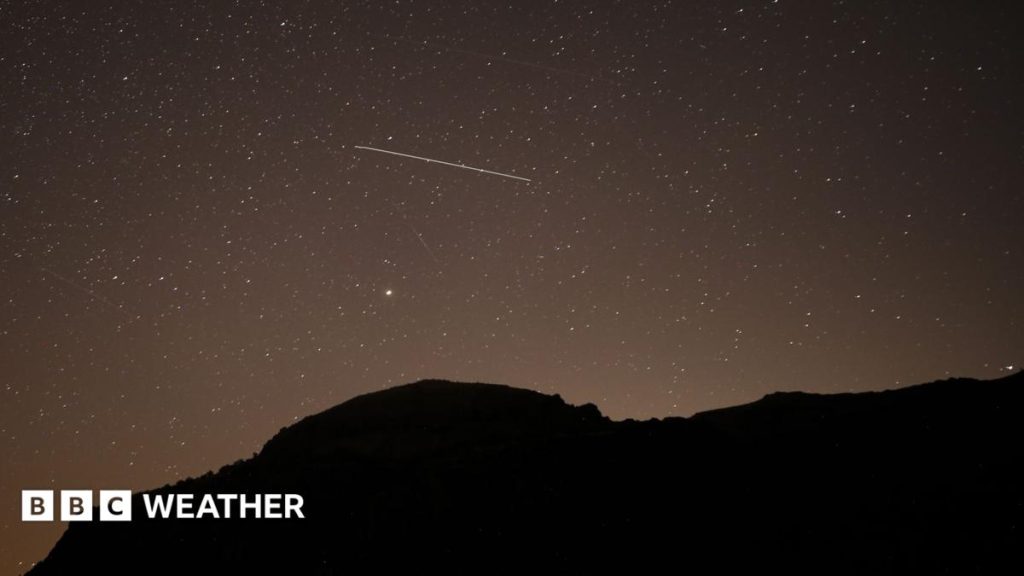
The Leonid meteor shower is set to dazzle sky gazers across the UK throughout November.
The celestial spectacle takes place from now until 30 November with the peak taking place on the night of 17 November.
There could be the chance to spot up to 10-15 meteors per hour.
The shower is made up of dust particles from the Comet 55P/Tempel-Tuttle, which leaves a trail of debris as it follows its path around the Sun.
These particles enter the Earth's atmosphere at up to 44 miles (71km) per second – meaning these streaks of light are the fastest meteors in the sky.
Experts advise finding a safe, dark location away from sources of light pollution such as street lights.
The meteors will be visible with the naked eye, with no binoculars or telescope required.
However, giving your eyes some time to adapt to the dark – perhaps 20 or 30 minutes – will give you the best chance of spotting them.
A wide open space is the best place to be, giving a full view of the night sky.
Meteors could be visible anywhere but the Leonids' radiant – the point from which they seem to appear – will, as the name suggests, be around the head of the constellation Leo, meaning this is the best part of the sky to focus your gaze.
As with all celestial spectacles, clear skies will be a must.
What is the forecast on Saturday and Sunday evenings?
This weekend's forecast will not necessarily be great news for those hoping to catch the start of the shower.
While the weather will often be dry, large amounts of cloud are expected to fill the sky in many areas with the chance of a few spots of rain or drizzle.
At the moment the best opportunities for clear skies appear to be in southern and western areas of England and Wales on Friday and Saturday nights, with more cloud in northern England, Northern Ireland and Scotland.
By Sunday night it is likely that more parts of the UK will be clear.
However, fog could be an additional issue, forming in any areas where skies remain clear for any length of time, obscuring the view.
Overnight temperatures will drop into single figures with the chance of a touch of frost in a few locations so if you are looking at the night sky for any length of time you will want to wrap up warmly.
You can always check the hour-by-hour cloud, fog and temperature forecast for your area by checking BBC Weather online or the app.
And if you miss them this weekend then take heart that viewing conditions look particularly good around their peak in the middle of November. This is because the Moon will be below the horizon around midnight, meaning its reflected light will be less likely to spoil the view.


Discussion