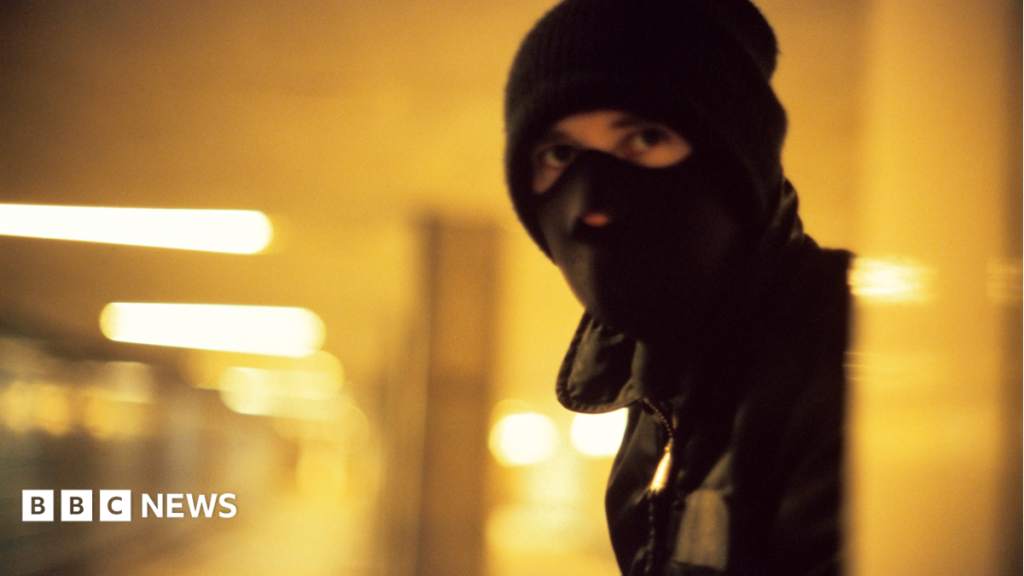
National headlines were made this autumn when Nottingham became one of the UK's first cities to bring in a balaclava ban, with neighbouring towns and cities now looking to follow suit.
Since September, authorities in the city have had the power to request face coverings are removed and to issue fines if they "reasonably believe" they are being used to cause trouble – although to date, no fines have been handed out in Nottingham.
But 12 miles (19km) away, one small town in Derbyshire has been quietly pioneering a ban for more than two years.
Heanor, a market town with a population of more than 24,000, took action after an increase in reports of anti-social behaviour.
As in Nottingham, Heanor's balaclava ban is part of a modified public spaces protection order (PSPO), which was drawn up in the face of rising problems of anti-social behaviour in early 2024.
It allows police and community protection officers to ask people to remove face coverings if worn in an attempt to conceal their identity to cause harassment, alarm or distress.
This includes scarves, masks, and balaclavas, but not coverings worn for religious or cultural purposes.
Amber Valley Borough Council, the authority responsible for Heanor, said concerns had been raised at the time over "group-related anti-social behaviour", which included people wearing face coverings" in a way that was causing alarm among residents and visitors".
Other incidents included reports of eggs being thrown at members of the public, along with "reckless" and intimidating behaviour on bikes and scooters.
PSPOs are not uncommon. So much so, they largely follow a template when introduced – no begging, no drinking, no urinating and defecating in the street, among other measures.
But in Heanor, Derbyshire Police's beat officers brought a wishlist of ways to amend the order.
These included restrictions on cycling, skateboarding and scootering in the PSPO area, playing "unreasonably loud" music, gathering in groups, and face coverings.
"We said these are what we would like to put forward as conditions, what do your legal team say about it?" PC Levi Tabbron said.
"And to our disbelief, they actually got approved."
So fast forward two and a half years, has the ban made a difference?
The force said there were no exact figures for incidents dealt within the PSPO area under its terms.
When it comes to fines, the borough council said police had issued two fixed penalty notices under the PSPO. Both were paid.
According to police-recorded data published on Police.uk, in February 2024, the month the PSPO was being passed, across all of Heanor and Loscoe there were 46 reports of anti-social behaviour, including crimes which do not fall under the PSPO regulations.
A year later, there were 25 reports of anti-social in the same area in February 2025, and in February this year 15 reports were logged.
The council added the PSPO "is one part of the wider work taking place with partners to address anti-social behaviour" – and that it was "not aware of significant ongoing problems in the town centre".
PC Tabbron said the balaclava ban, and other elements of the PSPO, were not just a stick to beat troublemakers with.
She said: "We don't want to issue out fines willy-nilly, because that doesn't help in every situation.
"The tickets that have been issued, it's made a clear difference when they have been because word gets round. But if we can engage, persuade and advise first off before the tickets even come into place, then brilliant.
"We're not going to just see somebody on a scooter or an e-scooter, go up to them go 'oh we're seizing your e-scooter and you're having an £100 fine' all in one day.
"If we've got a rapport with the community, they're more likely to work with us in the long run.
"We want to remind the public that the PSPO is in place, we will be looking at using it if we need to, and also remind those that are potentially breaching the conditions that we will be looking out for it."
Heanor was not the only place to dream up a ban on face coverings, although it was one of the first.
Wolverhampton has had a ban for a few years already too, Stafford has one coming in to force in December, while cities like Derby, Stoke-on-Trent and towns like Mansfield and Loughborough are also considering following suit.
Ward councillor for Heanor West at Heanor and Loscoe Town Council, Paul Jones, felt the ban was a good example to other towns and cities in the UK.
He said: "I think any sensible person's got to welcome it, you have to have a really extreme, valid, reason to go around with balaclavas on.
"The problem we have is there's lots of people on e-bikes with balaclavas, driving around intimidating people and it's very difficult to recognise them and take action.
"But in principle I think it's a great idea and we should encourage more assertive action by the police in stopping the young people trying to be disruptive to the local community, because it puts people off coming."
Speaking to a dozen or so visitors to the town centre, most agreed a balaclava ban was a sensible measure – although only one resident the BBC spoke to was aware that Heanor already had one.
Carol Wilkinson, 72, said congregations of masked youths were "intimidating" in the town's Market Place, and added: "Come teatime, you do see groups on bikes.
"I know children have got to go somewhere but they seem as though they're just bothering about – if you know what I mean."
Andrew Guest, 71, of Heanor, said: "Personally, I believe maybe they should be banned. You immediately think something's going on.
"Older people like myself, and ladies, do get concerned. When they see a gang, quite often they'll take the opportunity to cross the road, stay out of the way, hope nobody takes anything up with them and pass by as soon as possible."
Heanor "is not like how it used to be", fellow resident Karen Marsh felt, who said people might be avoiding the town centre.
She said: "I think balaclava bans are absolutely right. I think it's a bit intimidating for people when somebody's got a balaclava on and you can't see the face."
Heanor resident Tamsin Cox, 68, has noticed bad behaviour stretching out to other areas – not just the town centre.
She said: "We're in a WhatsApp group and every day there's messages about anti-social behaviour, about people riding, people covering their faces, people speeding, doing wheelies.
"They're not only asking for trouble, they're putting other people in danger."
All face coverings ought to be banned, Martin Storer, 71, from Marlpool just outside the town, said.
He said: "We don't really come into Heanor at night – well that would be one of the main reasons I suppose.
"For two and a half years, you've been seeing people walking around with balaclavas on so obviously the police aren't doing their job."
Claire Winfield, 67, was the only resident approached who knew there was a PSPO in place.
She said: "I think there is an issue – I think it gets a lot of press that it's getting worse but I'm not sure that it is, it's always been kind of a low level of anti-social behaviour.
"You do see kids going round with their faces covered in the summer where you think, that's not really a cold factor, it is so people aren't being identified.
"It's probably a good idea. I guess the problem is enforcing it."
Tell us which stories we should cover in Derby
Listen to BBC Radio Derby on Sounds and follow BBC Derby on Facebook, external, on X, external, or on Instagram, external. Send your story ideas to eastmidsnews@bbc.co.uk, external or via WhatsApp, external on 0808 100 2210.
More coverage
Rolls-Royce incident prompts emergency response

Trident submarine returns home after record-breaking undersea patrol
Eleven officers convicted of crimes still on Police Scotland payroll, chief confirms
Discussion