Junta’s forces ‘violently killed’ 10,000 members of Rohingya Muslim minority, Hague court finds
Myanmar’s military junta has been found guilty of committing genocide in a ruling that could have implications for Israel and its war on Gaza.
The International Court of Justice (ICJ) in The Hague, the UN’s highest court, said Myanmar had systematically attempted to destroy the Muslim minority Rohingya population. It is the first time in its 81-year history that the ICJ has found a state guilty of genocide.
The 2017 attacks led to one of the largest movements of people in modern history, with hundreds of thousands fleeing violence across the border to Bangladesh. The court said the attacks constituted more than an attempt to contain unrest in the region through military means.
The judges said: “The execution of Rohingya men and boys in some locations, the widespread sexual violence, the targeting of children and babies, the methodical burning of villages, and attacks on fleeing civilians are not consistent with an intent to conduct counterinsurgency operations.”
The judges ruled by nine votes to six that it had been genocide.
Sir Jeremy Hunt, a former Conservative foreign secretary, and co-chair of the UK Parliament’s all-party parliamentary group on Burma, told The Telegraph: “The court has confirmed what everybody knows, namely that the Myanmar government planned genocide.
“Now Britain, which holds the pen for Myanmar at the UN, must lead an international coalition to make sure there are serious consequences for this evil regime. There are many other problems in the world but we should never turn a blind eye to genocide.”
Ed Miliband said the Government had ordered Myanmar’s defence attaché to be expelled from the country following the ruling.
He said the UK was also summoning Myanmar’s chargé d’affaires and pledged to set out “further action in the coming days to ensure those responsible are held to account”.
The ruling will have profound implications for other politically charged cases, most notably the allegation of genocide that has been brought against Israel for its actions in Gaza.
Judge Iwasawa Yuji, the president of the court, said at a hearing on Thursday: “The court concludes that all the evidence before it, taken together, supports a reasonable inference that Myanmar’s security forces acted with genocidal intent.”
The court rejected Myanmar’s claim to have been fighting an insurgent terrorist force.
The judges said that dehumanising hate speech, bulldozed villages and widespread corralling of the population all pointed to a systematic attempt to destroy a significant part of the Rohingya population, as did direct killing and other violence.
The Rohingya have long been denied basic rights in Myanmar and nearly all have been denied citizenship in the former British colony since 1982, effectively rendering them stateless.
The court noted that in August 2017, Myanmar’s military launched what it called a “clearance” on the west coast of the country in response to an attack by a Rohingya insurgent group.
Government security forces moved through village after village in Rakhine State, burning homes and killing and raping thousands of men, women and children.
The court found that 10,000 Rohingya had been “violently killed” during the operation. It said this equated to “1.2 percent of the overall Rohingya population in Rakhine”, some 815,000 people.
In addition, the genocidal campaign forced more than 700,000 Rohingya to flee to neighbouring Bangladesh in 2017.
Before the attacks, the Rohingya made up about 2 per cent of Myanmar’s 55 million population; after the onslaught that figure fell to less than 1 per cent.
The fact that some survived and continue to live in Myanmar was not evidence that genocide had not been committed, as the junta had attempted to argue, said the court.
Around 1.2 million Rohingya refugees now live in Bangladesh, primarily in congested camps across Cox’s Bazar district amid harsh conditions and strict work restrictions.
Of the 17 attacks and subsequent persecution, the court said: “The court finds that Myanmar’s security forces killed thousands of Rohingya civilians, perpetrated widespread acts of sexual violence, as well as acts of extreme violence against children, and attacked fleeing Rohingya.”
The “only reasonable inference” was that the Myanmar state had aimed to intentionally destroy a “substantial part” of the minority Rohingya population, it added.
In a ruling that will cause concern in Israel, the judgment looked at a wide spectrum of evidence to establish genocidal intent such as hate speech from senior officials, withholding aid and destroying housing and infrastructure.
The legal accusation of genocide against Israel, which it denies, has been brought by South Africa. As with the Rohingya case, which took nine years to decide, a case against Israel would take years.
In preliminary public hearings last year, Israel insisted that its war in Gaza was a legitimate defence of its people and that it was Hamas members who were guilty of genocide.
The International Court of Justice can hear cases of genocide only when a case has been brought by a member state, and this is only the third case it has heard.
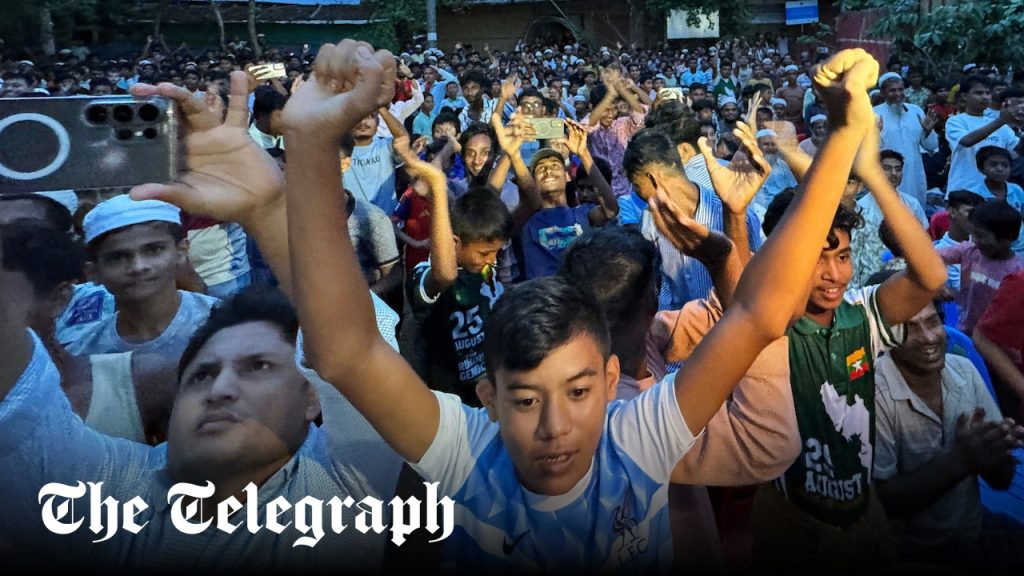
Survivors watch verdict on big screen
Before the verdict, the US warned the ICJ against “over-reach”. In a social media post, Mike Waltz, the US ambassador to the UN, said the court “must not be allowed” to establish a standard for genocide that could be used to target “allied soldiers”.
The ruling was welcomed by Rohingya survivors, including those watching on a big screen live-streaming the judgment to refugee camps near Cox’s Bazar.
Tun Khin, co-founder and president of the Burmese Rohingya Organisation UK, left Rakhine aged 17 and has never been able to go home.
He told The Telegraph: “More than 390 villages were burned down by the Burmese military, thousands of Rohingya women were raped, and many children were thrown to the fire.
“So this case is a historic moment for our community. We have suffered for many decades, but this is the first time we’ve been heard in court.”
Matthew Smith, the founder of Fortify Rights – a rights organisation that has supported the genocide case – said one of the most powerful moments was when Rohingya travelled to The Hague to give evidence in a closed-door session.
He said: “People were in court, sharing what they witnessed, what they survived – people were very moved, I understand that even many of the judges were moved by the testimony.”
Antonia Mulvey, the founder of Legal Action Worldwide, a group that represents hundreds of Rohingya survivors, told The Telegraph the testimony had come from three genocide survivors.
She said: “NJ, who was gang raped and had her baby killed in front of her; MS, who described the last time he saw his wife and children who were taken away, and we know who died – more than 50 members of his family died that day; and MN, who described the attacks on his village. More than 18 members of his community died that day. [It was] very powerful testimony.”
The court’s verdict is legally binding, final and cannot be appealed. However, other cases related to the crimes against the Rohingya are ongoing – including at the International Criminal Court, and in Argentina under the principle of universal jurisdiction.
These have named individuals, including Min Aung Hlaing – the military general who has characterised the Rohingya as a “long-standing Bengali problem”, and for whom there is already an arrest warrant – but also Aung San Suu Kyi.
The Nobel peace prize winner has support in parts of Myanmar, but her international reputation was marred when she chose to represent it in the Hague, defending the country in December 2019.
In February 2021, her government was toppled in a coup led by Min Aung Hlaing, ending a decade of development and democratic promise. The country was plunged into a brutal civil war, and Aung San Suu Kyi remains under house arrest.
Earlier this year, following controversial elections supported by China but decried as a sham by the West, Min Aung Hlaing became the civilian president. He is now trying to rebuild relations with neighbouring countries. Thursday’s verdict will make that more difficult.
The crime of genocide was established after the Holocaust by the 1948 Convention on the Prevention and Punishment of the Crime of Genocide.
It is defined as the “intent to destroy, in whole or in part, a national, ethnic, racial or religious group, as such”, and is exceptionally difficult to prove because of the need to prove intent.
Although the term genocide is widely used colloquially, the crime itself is rare compared to other crimes against humanity and war crimes which are not defined by intentionality.
Protect yourself and your family by learning more about Global Health Security
More coverage
‘I lost my family when I contracted HIV’: why virus is still taboo in Iraq
Anthropic achieves $2tn valuation as shares soar
Bosses ‘increasingly reluctant’ to hire as employment costs soar

Discussion