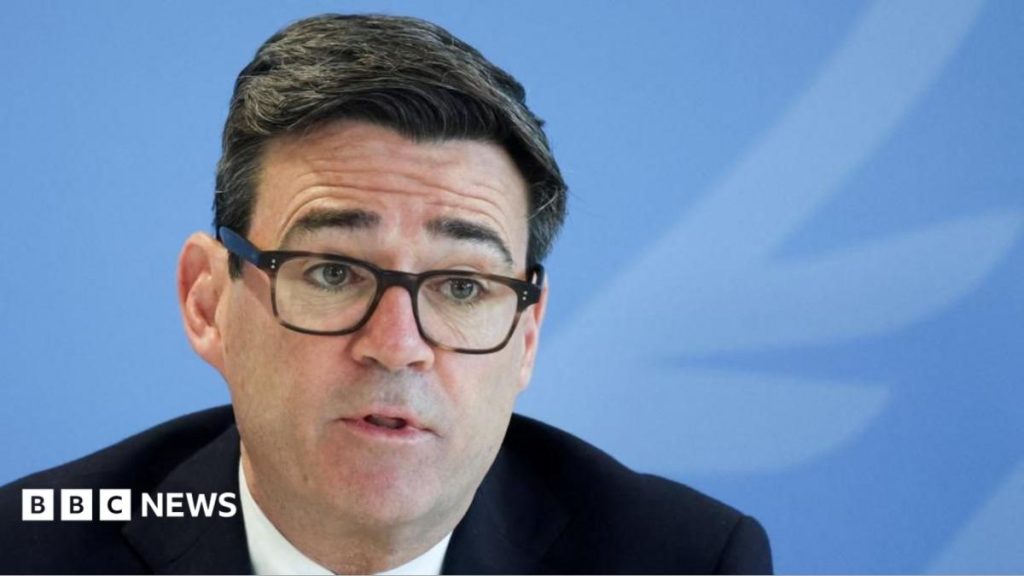
Andy Burnham said he wants to cut the welfare bill "as soon as we possibly can", but was unable to guarantee this would happen before the next general election.
Opponents raised concerns over the lack of details on welfare reform in Wednesday's Budget, after welfare spending was forecast to increase from £353bn this year to £431bn in 2031/32.
Asked whether he would seek to reduce the bill before the next election, Burnham told reporters: "We want to get the welfare bill down as quickly as possible, and we're working flat out to that end."
He warned against "crude cuts" and said he wants to get people into "sustainable employment". The Conservatives accused Labour of being "addicted to welfare".
Budget 2026: Key points at a glancePublished22 hours ago
Budget 2026: Key points at a glance
The prime minister faced questions about his approach after the Treasury disputed that Chancellor John Healey had suggested to the BBC that the benefits bill will be cut before the next election, which must be held by August 2029.
When Healey was asked by the Today Programme on Radio 4 whether there would be a cut in the bill before polling day, he said: "There will be, there will be a reduction in the benefits bill, we'll do that in a Labour way."
But several Treasury sources took issue with this being interpreted as a promise to do so by the next election. Downing Street later said it was "not setting an arbitrary target or timetable".
The prime minister's official spokesman would not say whether the government's ambition to cut welfare spending meant reducing it below its current level, or ensuring that future spending rises at a slower rate than is currently projected.
Further details about the government's proposals are expected after two major reports are published in November.
These include a review of disability benefits co-chaired by Labour minister Sir Stephen Timms and one on young people not in education, employment or training (Neet) led by former minister Alan Milburn.
The two reviews were announced by former Prime Minister Sir Keir Starmer after his attempt to make significant changes to the welfare system, including restricting eligibility for some health-related benefits, resulted in a mass revolt of Labour MPs and an embarrassing climbdown in June 2025.
Speaking during a visit to Derby, Burnham said the "big next priority in front of us" is the publication of the Milburn report.
He said: "We just want to get stuck into supporting people to help people off benefits and into work. There's no delay there. We want that to happen as quickly as possible."
Pressed again for a timeline on his plans, the prime minister said: "We're working hard to cut the welfare bill as soon as we possibly can. But we're doing it in a way that supports people into work.
"If we just went and made crude cuts, in the end, that leaves people in crisis, and you spend more public money somewhere else, so it's about getting people into sustainable employment."
Former Bank of England chief economist Andy Haldane said if the government could provide a plan to show "greater restraint" of the benefits bill, that would "play spectacularly well" with the financial markets.
Haldane, who has previously advised Burnham, told the BBC's Political Thinking with Nick Robinson podcast: "If the government could get that through I think it would come with a huge bonus."
Conservative Party leader Kemi Badenoch responded to the Budget by saying the country was "overspent, overborrowed, overtaxed, and drowning in an out-of-control welfare system".
Reacting to government briefings and remarks on Thursday related to when a reduction in the benefits bill could take place, Badenoch said it "looks like foot in mouth syndrome is spreading".
She said: "Don't let anyone tell you this was a 'do no harm budget'. In doing so little, Labour have harmed our economic security and they've harmed our national security."
Welfare spending is forecast to rise this year by £19bn to £353bn.
Watchdog and forecaster the Office for Budget Responsibility (OBR) said this figure is expected to rise to £431bn in 2031/32, driven primarily by health-related and pensioner benefit spending.
Of the figure forecast for 2031/32, £209.8bn is on pensioners, including the state pension and winter fuel payments, while £110.7bn is on universal credit and legacy equivalents and £69.6bn is on disability benefits such as personal independence payments.
The government has already pledged to reform the existing state pension triple lock from 2030, and more proposals and changes to the welfare system are expected to emerge in the coming months.

Discussion