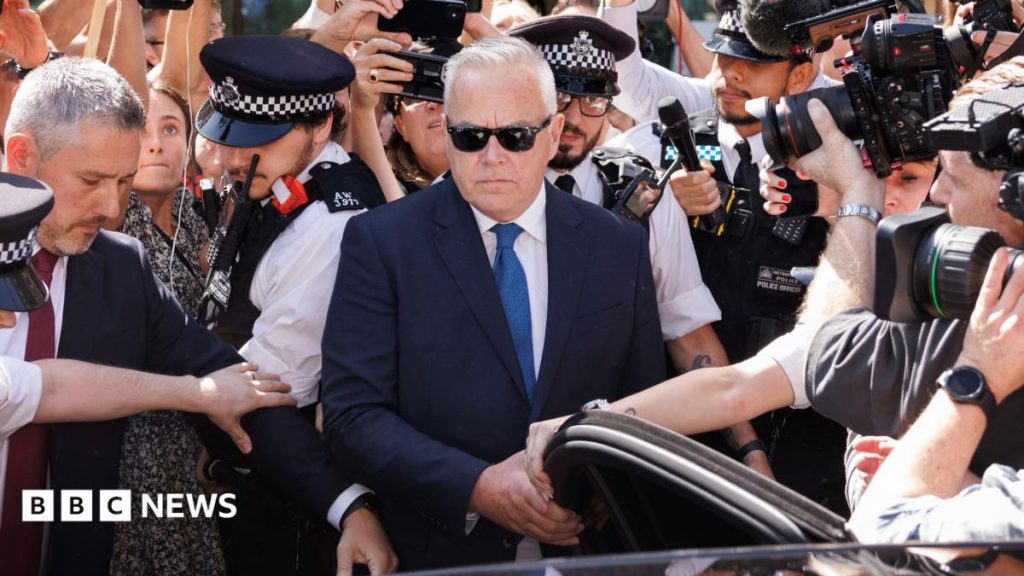
Huw Edwards used to be one of the BBC's most recognisable faces, whose measured delivery of the news so often perfectly matched the mood of the nation.
Now, in a Channel 4 documentary to be aired on Tuesday, the disgraced presenter comes across as angry, self-absorbed, vain – and even, at times, delusional.
Since it was announced, Huw Edwards – Guilty has been at the centre of controversy, with sexual abuse survivors, charities and politicians criticising Channel 4's decision to give a platform to a convicted sex offender.
He says he's done the documentary "because I feel I owe it to people to explain why things went as catastrophically wrong as they did. I feel I owe people an apology, a profound apology".
Having seen a preview copy, I can tell you that there are many jaw-dropping moments in the programme, but none is likely to rehabilitate his reputation. He says he's not looking for a comeback.
But was there any public interest in making it, as Channel 4 insists? Similarly, is there journalistic merit in the Observer newspaper's own interview with Edwards – the first part of which was published on Sunday, and which has been made separately and has its own five-part podcast?
Patrick Forbes, director of the Channel 4 documentary, followed Edwards for nearly a year. There's a big interview on an empty, windswept beach in South Wales.
We see Edwards visiting his counselling psychologist as well as his mother, who has dementia and is in a care home. We are with him in a car on his way to Bristol Airport because he needs to "escape" what he calls "an absolute gutful of press abuse".
This is around the time Channel 5 broadcast its drama, Power: The Downfall of Huw Edwards, starring Martin Clunes.
In the documentary, we are told Edwards is bisexual and that this has caused him "a lot of turmoil". He addressed those feelings only later in life and had an affair with a man while still married to his wife.
We also hear his fury at the family who spoke to the Sun newspaper. It broke the original, and entirely separate, story about him paying what it calls a "vulnerable teen" for sexual pictures. He says that claims the young man was underage are untrue, and berates the mother.
"Why don't you tell us how much you were paid then for your contributions to the Sun? And – if it was nothing – tell us it was nothing."
He shared with the documentary the man's birth certificate, which appears to show he was nearly 19 when he first messaged Edwards.
He often appears catty and competitive, for example about his role on BBC News at Ten.
"You are the BBC's main news presenter. Fiona Bruce thinks she is, but, you know, she's not. I am," he says.
"Lots of jealousies, lots of resentments. 'Why's he doing that when I could be doing it?'.
"Well, the answer to that is very clear. He's much better than you. That's why."
It seems revealing; that sense of entitlement is the kind of delusional behaviour media institutions including the BBC want to stamp out. The belief that nobody else is as good as them enables high-profile figures to get away with abuse of power.
Another revelatory comment is Edwards' claim that his colleagues thought he was "far too big" for his boots so "when I served up to them on a silver platter the biggest disaster of all time, I think they had four days of partying probably".
That "silver platter" involved him receiving illegal child abuse images. Does he really think that led to celebrations?
I remember the period. I was reporting on it. The newsroom was in shock.
He also attacks the former Guardian columnist, now podcaster, Marina Hyde as a "professional bitch".
She wrote a column for the paper after he responded to Channel 5's drama with a statement about his regret and remorse – and his mental health battle.
He tells Channel 4: "How can that be the subject of some satire or some parody that she trots out one morning while she is chomping on her granola?
"I just find it sick. It's put me back by six months."
Perhaps he's self-involved as a result of the past few years. Perhaps he's always been self-involved. But as a piece of television, you often want to look away.
The regulator Ofcom is investigating the Channel 5 drama after Edwards complained it was misleading and unfair. He may be vindicated. We may learn more about the Sun's evidence for its original story.
Edwards is combative. When it comes to the BBC, there is no conciliatory tone.
Many will view his reasons for not returning the £200,000 the corporation paid him after his arrest as deluded. He's furious that his broadcast "contributions", including presumably his announcement of the death of Queen Elizabeth II but also the documentaries he made, are being "erased".
"If the BBC wants to stop airbrushing me out of its history, we could talk about a payment," he says.
Edwards received 41 images of child abuse. He did not cut off contact with the sender of those images – who was also sending him adult content – and he did not report him to police.
Edwards has previously talked about his ongoing struggle with depression. As an audience – and as readers of the Observer – we're being asked to understand the role his mental health played in his downfall.
He talks of "25 years of mental agony" and says "people need to realise what happens when you are seriously mentally ill".
That last exchange is probably one of the few moments in the documentary when he faces a bit of challenge by the filmmaker. Edwards' explanation for how he came to be sent child abuse images is that his life had spiralled and "I'd lost the plot". The filmmaker pushes back, saying: "Come on."
And Edwards angrily turns it back on his interviewer.
"I was ill and the dismissive attitude that you have just given there to 'lost the plot', which is my polite way of saying you've gone nuts, is actually – it was very dismissive and that's entirely typical of the response that is promoted by the press."
It's a hostility that doesn't reflect well on him.
'Lack of rigorous interrogation'
Of course, some may feel empathy. They may agree he has been badly treated. The Observer's interview – by editor Ceri Thomas, a former BBC News editor – explores Edwards' argument that he is being unfairly characterised as a paedophile.
It reports that the chief magistrate who sentenced Edwards – after he pleaded guilty to three offences of making indecent images of children ("making" in this case being opening after receiving) – accepted that he asked not to be sent any "underage" material, did not pay for it directly, did not "see or read any descriptive material" attached to it, store it, send it to anyone else or "gain any gratification" from it.
In the Channel 4 documentary, Edwards says that the first time he was sent indecent images of children "my memory is I clicked on something and thought 'God, what is that?'"
He says he deleted the image.
"It was something that clearly looked illegal. It was a young person or a child of some kind. I can't tell you it was x or y, all I can remember is opening and thinking 'Oh God, that's horrible, delete'."
He tells Channel 4 he messaged Williams "saying 'never send me stuff like that again', I said 'you know, that's just not on, you're going to be in big trouble and I'll be in big trouble, never send stuff like that again'".
Edwards claims Williams apologised and promised not to send any more.
"And then he sent another lot. And again on the second time, I remember a vague sense of 'Oh my God, he's done it again'."
But the lack of rigorous interrogation of the detail leaves Channel 4 – and the Observer – in an uncomfortable place.
Channel 4 hit with fresh criticism ahead of Huw Edwards documentaryPublished5 hours ago
Channel 4 hit with fresh criticism ahead of Huw Edwards documentary
'We have no interest in hearing from Huw Edwards', Downing Street saysPublished2 days ago
'We have no interest in hearing from Huw Edwards', Downing Street says
Disgraced newsreader Huw Edwards' blog shows staggering lack of awareness, campaigners sayPublished26 June
Disgraced newsreader Huw Edwards' blog shows staggering lack of awareness, campaigners say
Here's a reminder of the timeline laid out in court.
The prosecution at the time of Edwards' sentencing said he was first sent images of underage boys in December 2020, including a video in the most severe category of illegal material. Further images were shared in January 2021 of boys aged between 13 and 16.
In February, he received a video – in the most severe category of illegal material – involving a child aged around seven to nine. More underage images were sent in February before Williams asked if the material was "too young for you" and Edwards replied: "Don't send underage."
Then in August 2021, the prosecution said, Edwards was sent a video of a boy aged seven to nine being sexually abused. He asked where the video was from. When Williams then said the subject was "quite yng looking", Edwards responded that it "can be deceptive" and asked if he had "any more?".
At sentencing, the magistrate told Edwards: "You told the individual who sent the images not to send images of people who were underage, but only at a later stage, which is not from the beginning, this is not a case where despite protestation not to nonetheless the images were still sent."
Yet neither Channel 4 nor the Observer challenge Edwards on the claim that he immediately instructed Williams much earlier not to send "stuff like that".
There are so many moments in the documentary when his words feel off. It makes you wonder whether silence really would have been the best course to take, as his lawyers appear to have advised.
"The worst mistake of my life was joining Instagram" he says a few minutes into the programme. Surely the worst mistake of his life was engaging with a man who sent him illegal images of children – and then not contacting the police about it?
He accuses the police of "rather glibly" pointing out – when he was being questioned by them after his arrest – that he hadn't reported the indecent images to them.
He turns the accusation back on them.
"I didn't report it first because you're the Met and you can't be trusted and second because, had I reported it, which I would have done, that would have been the end," he says.
Edwards' police interview was in 2024. Until he got caught, he was protecting his career. Many might understand that instinct – but he was thinking of himself only.
He tells the Observer he is "ashamed" to say he didn't even consider reporting Williams to the police when he received the images.
He is angry at the way he feels he has been treated by the media since the stories first broke.
"It is three years since I last broadcast," he says at one point. "Three long years and you just think, how long do people want to feast on the carcass?"
This from a man who will remain on the sex offenders' register for another five years.
When the minister John Profumo lied to Parliament about his affair with Christine Keeler in what became known as the Profumo scandal, he disappeared from public view. For years. Profumo did charitable work and stayed silent.
Edwards seems to think he's already paid his dues.
He was sent 41 indecent images of children – comprising photos and videos. Seven were category A – the most severe.
He tells the documentary that a paedophile is "somebody with a sexual interest in children, which I am not".
The key question at the heart of this is whether interviewing a convicted sex offender is justified.
Channel 4 argues it is holding Edwards to account. It says the discomfort some may feel was "not, in itself, a reason for journalism not to ask difficult questions".
I didn't see much evidence of real accountability – or difficult questions being pursued in the programme.
Perhaps the filmmakers thought Edwards does such a good job of damning himself, they didn't need to ask him too many tough questions.
The Observer's leader argues there is "value" in revisiting what happened "in search of facts".
We know that platforming convicted criminals retraumatises victims. In Edwards' case, the fact that he is back on the front pages is presumably also retraumatising his estranged family. During the documentary we learn that his son has pulled out of a meeting with him – having not seen him for many months.
But I wonder also whether perhaps Channel 4 and the Observer had a duty of care to Edwards too. The paper reports that he has attempted suicide twice in the years since he lost his job. His mental health is clearly still poor.
He talks about how he would "give all the money in the world" to still be married. Even then, his reasoning seems callous.
"That isn't because of the comfort of it, and it isn't because I still love her and it isn't because I want to recreate something that can't be recreated because of all the things that have happened," he says.
"It's because that's the relationship I would want. Would I want to live with a guy? No. That's not something I'd want."
Some will find that internalised homophobia difficult. Others may take issue with him effectively saying he wants to be with a woman, but doesn't love her.
Newsnight's interview with the then Prince Andrew was a triumph of forensic questioning. He was already a controversial figure although he hadn't – and has not – been convicted of a crime. But the decision to interview him was clearly in the public interest.
The Channel 4 documentary is not full of forensic questioning. It makes it harder for the broadcaster to make the public interest argument.
And its protagonist is likely to face another deluge of abuse once it is broadcast.
He's a diminished figure in the programme – vaping constantly, wandering the beach. Perhaps – in the end – Huw Edwards also needed protecting from himself.
Discussion