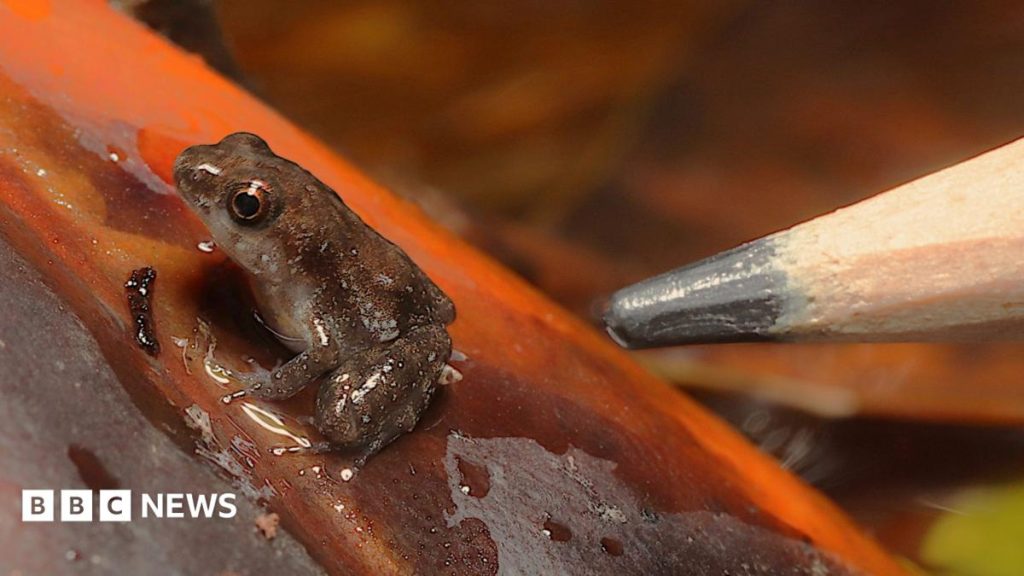
Fifteen critically endangered frogs have hatched at London Zoo, which says marks the first time the species has been bred in captivity.
The Afia Birago's puddle frog lives in Ghana's Atewa Hills Forest Reserve, where the Zoological Society of London (ZSL) says it survives in just two pools that are both under threat from mining.
Twenty adults were brought to London in September 2025 so experts could learn how to care for and breed them, and pass that knowledge on to conservationists in Ghana.
The froglets are about 5mm long, roughly the size of a pencil tip.
Ben Tapley, curator of reptiles and amphibians at ZSL, which runs the central London zoo, said: "They may be tiny enough to sit on your fingertip, but their arrival represents a huge step forward for an amphibian facing an uncertain future."
ZSL said no other zoo or institution was known to keep the species.
It was only described by scientists in 2018. Fully grown, the frogs weigh less than 1.75g.
ZSL said almost nothing was known about them when they arrived, and keepers have since developed breeding techniques that are being shared with the CSIR-Forestry Research Institute of Ghana's breeding centre in Kumasi.
The aim is to build up a population in Ghana that could be released into the wild.
Ghanaian conservationist Caleb Ofori-Boateng, who helped identify the species, named it after his mother, Afia Birago.
"I named this frog after my mother so that her legacy would live on," he said.
"Thanks to this breeding programme, it will. Her name will be linked to a species we saved, not one we lost."
The births follow the zoo's success last November in breeding the Atewa slippery frog, another critically endangered species from the same forest, which had also never been bred in captivity before.
Listen to the best of BBC Radio London on Sounds and follow BBC London on Facebook, external, X, external and Instagram, external. Send your story ideas to hello.bbclondon@bbc.co.uk, external
Zoological Society of London
Discussion